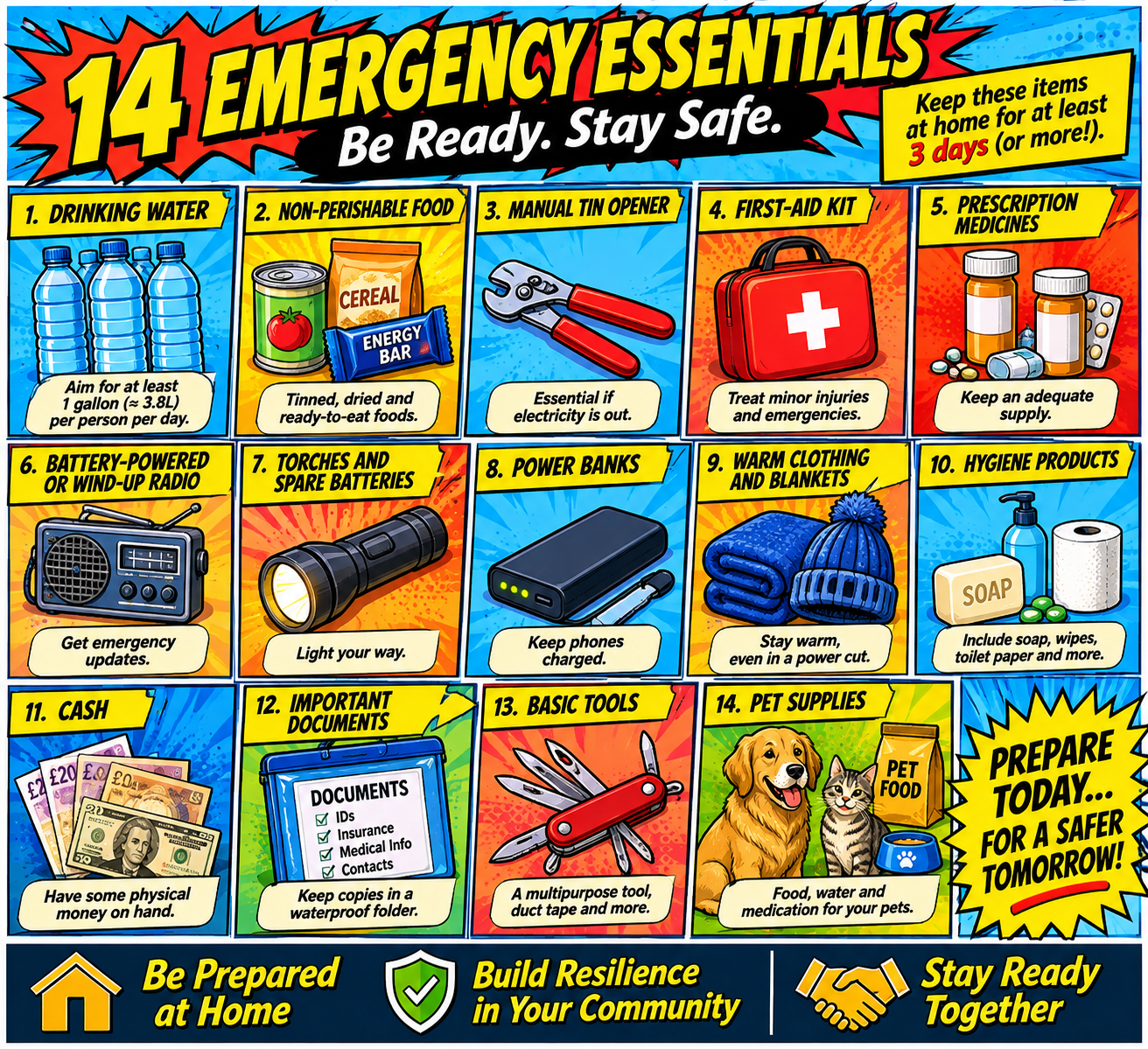
Recently, governments from all around the world including, the U.S. and the UK, have advised that people should be “prepared” and store “essentials” for emergencies.
In the U.S., the Ready.gov website and in the UK, the Be Ready Campaign both underline the importance of being prepared for severe weather, cyber attacks, power outages and other emergencies.
At the time of writing, mid November 2026, ‘coincidentally’ on Friday the 13th, Microsoft Outlook has seen the largest downtime outage in its history, with millions unable to send or receive emails or use services such as Microsoft Teams and Copilot for close to 24 hours.
In this article, we look at what entrepreneurs should do to prepare for national or global emergencies, and if there’s really something to be concerned about.
Here goes…
No Immediate Threat

The first thing to note is that the authorities are saying that there is “no immediate threat”.
While there is no specific threat, it should be noted that the U.S. is particularly vulnerable to severe weather conditions such as hurricanes, wildfires, earthquakes, flooding, and prolonged power failures, as are many other parts of the world.
In the UK, these events are less common, but the risk of flooding in certain areas has risen significantly in recent years.
So, while there is no immediate threat or specific danger, there is a risk that if something major were to happen, it would mean individuals and businesses could be caught out and severely impacted.
We are living in an increasingly connected and uncertain world, so it makes logical sense to be ready if the worst were to happen.
What Should Be Stored?

While the list differs from country to country, the basics are covered here. You should consult documentation in your jurisdiction for specific advice in your region.
- Drinking water: Bottled water is recommended; most governments recommend storing at least 3 litres of water per day per person for drinking and washing hands, etc.
- Non-perishable food: Tinned and dried foods are likely to last longer in an emergency, as are energy bars, nuts or other foods that do not require heating to eat.
- Manual tin opener: It’s very important to be able to get to your non-perishable supplies if the electricity supply is down..
- First-aid kit: It should include bandages, plasters, antiseptics and other emergency medical supplies.
- Prescription medicines: If you take regular medication, you should store an emergency supply subject to consultation with your medical practitioner.
- Emergency radio: A battery-powered or wind-up radio can provide essential news and information in an emergency. Should the internet become disabled, there may be no other way to find out what is happening.
- Torches and spare batteries: You should be prepared and store several sources of lighting, including handheld torches, rechargeable lanterns, and even glow sticks. Also, don’t forget the batteries.
- Power banks: Power banks are particularly useful as they can keep your mobile phone and laptop running. High-power devices can even be used to operate larger electrical appliances.
- Warm clothing and blankets: If the power goes out, temperatures can drop considerably. Prepare by storing warm clothing and blankets. It could be useful to have some waterproof clothing to hand too.
- Hygiene products: Staying on top of hygiene is important in an emergency to prevent infection and disease. Items to store include soap, sanitiser, wet wipes, toilet paper and rubbish bags.
- Cash: Surprisingly, cash is on the list of required items. In an emergency, it’s likely that ATMs and card payments will be disabled. So, keep a small amount of physical cash available.
- Important documents: Store copies of your passport, ID, insurance policies, phone numbers and emergency contacts in a waterproof folder.
- Basic tools: Basic tools such as screwdrivers, tape, scissors and repair equipment can be very handy in an emergency.
- Pet supplies: If you have a pet, you should also have the necessary supplies for your furry friend, including food, water, medical supplies, bedding, etc.
What Should Entrepreneurs Know?

Entrepreneurs need to understand that while individual preparedness is important, businesses face an entirely different set of risks for consideration.
These could include revenue loss, missed orders, stock damage and disgruntled customers.
Therefore, it’s essential that entrepreneurs have further contingency plans in place, despite the individual measures mentioned.
Here is a list of things to consider.
- Have alternative means of communication. Should email or mobile phone networks go down, you need alternatives. Do not rely on one form of communication to update your customers and staff.
- Have a plan. Ensure you have a business continuity plan so that in an emergency you have systems in place for events such as power failures, staff unable to travel and unavailable suppliers.
- Back up your data. Ensure you back up your data regularly before an emergency. This not only protects your data, but also allows alternative access should things go down. If you are relying on cloud services to store all your client information, will you be able to access it in an emergency when services are down? Aim to store backups at different secure locations if possible to minimise risk further.
- Financial resilience. Ensure you have a plan for reduced cash flow should payment services go down or clients stop purchasing for a period of time.
- Insurance. Ensure (no pun intended) you have sufficient insurance in place that covers the emergencies mentioned in this article. Make sure you read the fine print, since many insurance policies exclude ‘acts of god’ or unpredictable events.
- Customers. Aim to keep your customers updated while any emergency progresses. Have an alternative means of communication in place should regular communication channels become disabled.
- Ripple Effects. Be aware that despite all your contingency plans, there can be unexpected ripple effects in an emergency. For instance, if the email or mobile network were to go down, customers may not be able to authenticate online orders and staff may not be able to access systems that use two-factor authentication. Online contact forms may stop working entirely. Think about how your business could be impacted by the ripple effects of an emergency.
Final Thoughts

Being prepared does not mean there is an expectation that something bad will happen.
Savvy entrepreneurs understand that minimising potential risk is all too important in business.
Any prolonged event, as we’ve seen recently with the Microsoft outage, can cause significant disruption to businesses and have unexpected ripple effects.
For instance, email services going down can impact policing, courts, online order processing, and customer and staff logins to essential services. Even government services can be affected.
We are living in an increasingly technological and connected world, and any failure point is likely to cause disruption.
With that in mind, entrepreneurs should ensure that they store the emergency items mentioned in this article, and that they put in place contingency plans for business disruption.
Most importantly, having a good business does not only mean success when conditions are favourable, but also being able to continue when there’s a storm.
Resilience and preparedness are of utmost importance in these circumstances.
Are you ready?
Good luck!
Virtual Heaven (Back To Reality) 2017 – (Graham Jules)
Watch The Trailer on Pop Up World TV

Read about the full ‘Alien Agenda’ in an exciting Sci-Fi – Illustrated Screenplay Format Book – Limited edition copies available on Amazon. Virtual Heaven (Back to Reality) – by Graham Jules.
Read about the full ‘Alien Agenda’ in an exciting Sci-Fi – Illustrated Screenplay Format Book – Limited edition copies available on Amazon. Virtual Heaven (Back to Reality) – by Graham Jules.

***Disclaimer: This article is not financial advice and is given for informational and entertainment purposes only. Readers should conduct their own research and not invest more than they can afford to lose. Crypto is extremely volatile, and as such can drop in value considerably without notice. Pop Up World has a global presence and is not specifically targeting any jurisdiction with its content. Any crypto references are not intended for UK businesses or consumers. You should always seek legal advice to understand if the use or investment in crypto is allowed in your jurisdiction.
Pop Up World YouTube Reviews:
Review. Malik Atif – Hindi -Urdu
Review. Inside Crypto – Hindi – Urdu
Review. Convincing Crypto – English
The Pop Up World Token is designed specifically for entrepreneurs, to store value and to utilise on our platform Pop Up World. Join the revolution in financial freedom today.
Get the token on Cardano Decentralised Exchanges (DeXs), MuesliSwap, SundeSwap, Wingriders and Minswap. Or click the link here:
Pop Up World token has a growing ecosystem
Want to learn how to stake on Cardano? Read this article:
It starts with an idea. Pop Up World is a platform that helps start-ups and small businesses reach for the stars. No matter what size you are. Use our start-up guide Business Zero to Superhero, Design your Logo. Connect with investors via our Investor Connector. You can start a Website and Domain name. You can Search for and promote your Premises. You can promote your idea for free on our Pop Up World Ads site, you can even form a Limited Company You can also join us on our journey via the Pop Up World Token (PUW).

