
Recently, many content creators have been griping about the rule changes and increased monetisation requirements introduced by YouTube, many of which are due to start in Feb 2027.
However, despite the complaints, many still continue to use YouTube, with no apparent serious competition in sight.
In this article, we look at the reasons why YouTube has become so deeply embedded in the internet, and whether there is any viable competition that can give content creators other options.
Here goes…
The Competition

It can be argued that YouTube does not have any serious competition; however, the situation is a lot more complex.
There are platforms such as Twitch, TikTok and Rumble that have managed to build significant audiences. Twitch boasts 240 million monthly active users, TikTok 1.6 billion monthly active users and Rumble 47 million active users. There are even newcomers such as Pop Up World TV that are seeking to impact the video streaming market.
However, as yet none of these has managed to compete with the sheer size, scale of content, advertising and the global reach of YouTube. By contrast, YouTube boasts a whopping 2.58 billion monthly active users.
So, while there do appear to be serious competitors in the market, the real question to ask is why these options are not currently being chosen as alternatives?
Reasons for Creator “Stickiness”

While creators often complain about the rule changes on YouTube, many remain regardless. This ‘stickiness’ is due to a few reasons:
Network Effect
The Network Effect is an outcome that occurs when the more people that use a particular service or platform, the more valuable it becomes.
YouTube dominates because it has managed to build up over time a huge ecosystem of content creators, viewers and advertisers.
The network effect means that new content creators are drawn in by the amount of potential reach. Viewers are drawn in because of the amount of content, and advertisers are drawn in due to the number of viewers.
The effect is a cycle of needs and demands being met, which is very difficult for competitors to overcome.
Search, Advertising and Monetisation
Since YouTube is part of Google’s ecosystem, the platform benefits greatly through its advertising, search and monetisation system.
YouTube videos can be readily found in Google Search results, Google AdSense can be used to pay creators, and Google Ads can be used by advertisers to place ads.
All of these create a reliable ecosystem that creators can use to potentially build income.
So, while YouTube may not be the most lucrative and the rules are frustrating for small creators, it does have an established ecosystem that creators and businesses can build on.
Read more on YouTube’s shocking monetisation requirements:
Rebuilding an Audience
Creators may also be reluctant to move because it takes an extremely large amount of effort to build an audience.
Creators may also need to learn a new set of rules and regulations on a new platform, and there may be different monetisation policies that may also be in a state of flux, much like YouTube.
Competitors Strengths and Weaknesses

So, while it’s not necessarily correct that YouTube does not have any competitors, there are, however, strengths and weaknesses of the contenders.
1. Twitch
Twitch’s main strength is that it is a live streaming platform with a loyal community. Its main areas are in gaming, esports, live entertainment and creator communities.
Its main weakness is that it is strongly associated with live streaming and gaming. Twitch therefore does not offer the breadth of content that YouTube does.
2. TikTok
TikTok’s main strength is its short-form content and powerful recommendation engine. Viewers are matched with relevant short-form content, making it possible for even new creators to go viral should the content catch on.
However, the main weakness is that longer-format videos such as tutorials, podcasts and short documentaries are not easily catered for. For example, TikTok encourages a podcasting ‘link’ feature where creators can link full podcast feeds via RSS feeds or short clips via normal uploads.
TikTok has also had its fair share of monetisation rule changes that have caused frustration amongst its creators.
3. Rumble
Rumble’s main strength is that it acts as a video platform that is associated with free speech.
While YouTube’s algorithm often cracks down on controversial topics, Rumble appeals to creators who desire freedom of expression. Rumble also offers livestreaming and monetisation.
Rumble’s main weakness is that its community remains much smaller than YouTube’s. In addition, Rumble’s political associations may also limit appeal to advertisers and viewers.
4. Pop Up World TV
Pop Up World TV is a new addition to the fold that aims to offer new opportunities for content creators and viewers.
Pop Up World TV’s main strength is that, as a newcomer, it can develop a new and unique identity in the marketplace and potentially build a closer relationship with creators and viewers.
The main weaknesses Pop Up World TV and newcomers face are attracting a critical mass of users to enable the aforementioned network effect, and building a sustainable creator economy. These are significant challenges to overcome.
What Entrepreneurs Should Know

While YouTube is clearly the largest player in the market, that does not make it invulnerable to challengers.
A simple clone of YouTube is unlikely to work. Platforms that can build a closer relationship with creators and develop unique content may be able to do extremely well in the marketplace.
Content creators should be looking at diversifying across multiple platforms to take advantage of ‘early adopter’ monetisation arrangements.
Entrepreneurs and content creators should be aware that as YouTube becomes even more dominant, it’s likely to focus only on its largest content creators.
This may lead to revenue reduction for smaller creators or eventually zero revenue for the majority of small creators.
With that in mind, it may be prudent for entrepreneurs and content creators to start building audiences across multiple platforms.
Final Thoughts
On closer inspection, it can be seen that while YouTube is a dominant player in the video streaming marketplace, it’s clear that there are viable competitors.
However, that competition currently does not have the breadth and depth of YouTube video content and, most significantly, does not offer the wide range of video categories and services such as search, advertising and monetisation options.
While the main competitors have significant traction, the largest, TikTok, has less than half of YouTube’s monthly active users at 1.6 billion users.
However, all is not lost; while YouTube does dominate, competitors have significant strengths.
Twitch, for example, has managed to build a significant loyal user base surrounding live streaming. TikTok has built its model around short-form videos, and Rumble has based its strategy around free speech.
Even newcomers like Pop Up World TV have managed to differentiate by targeting independent content creators to build closer relationships with creatives.
With all this in mind, competitors that are looking to simply replicate what YouTube does are likely not going to do well.
Creators face significant challenges when building an audience on a new platform, so competitors will need to be unique to entice them.
As YouTube’s dominance grows, it may push to concentrate on its larger creators, making it difficult or even impossible for small channels to earn significant revenue.
Bearing in mind the dominance of YouTube, savvy entrepreneurs and content creators should consider building an audience on alternative platforms as soon as possible.
Therefore, entrepreneurs should not aim to replace YouTube but should look to supplement it with additional revenue streams from alternative platforms.
Entrepreneurs should also consider hosting their own website that streams their most popular videos to build their own contact list and to build a closer relationship with their viewers.
Good luck!
Why Pop Up World TV?
Creators get paid per Supporter (Subscribers), not on Views.
Only 100 Supporters are required to be eligible for the Revenue Program.
Viewers can select Random Support, so even new Creators can build Supporters over time.
No AI training on your video content.
AI content is ok, as long as it’s original.
No onerous algorithms.
Get Your Free Creator Premium Account by registering at:
Virtual Heaven (Back To Reality) 2017 – (Graham Jules)
Watch The Trailer on Pop Up World TV

Read about the full ‘Alien Agenda’ in an exciting Sci-Fi – Illustrated Screenplay Format Book – Limited edition copies available on Amazon. Virtual Heaven (Back to Reality) – by Graham Jules.
Pop Up World token has a growing ecosystem and is one to watch for the future.
***Disclaimer: This article is not financial advice and is given for informational and entertainment purposes only. Readers should conduct their own research and not invest more than they can afford to lose. Crypto is extremely volatile, and as such can drop in value considerably without notice. Pop Up World has a global presence and is not specifically targeting any jurisdiction with its content. Any crypto references are not intended for UK businesses or consumers. You should always seek legal advice to understand if the use or investment in crypto is allowed in your jurisdiction.
Pop Up World YouTube Reviews:
Review. Malik Atif – Hindi -Urdu
Review. Inside Crypto – Hindi – Urdu
Review. Convincing Crypto – English
The Pop Up World Token is designed specifically for entrepreneurs, to store value and to utilise on our platform Pop Up World. Join the revolution in financial freedom today.
Get the token on Cardano Decentralised Exchanges (DeXs), MuesliSwap, SundeSwap, Wingriders and Minswap. Or click the link here:
Pop Up World token has a growing ecosystem
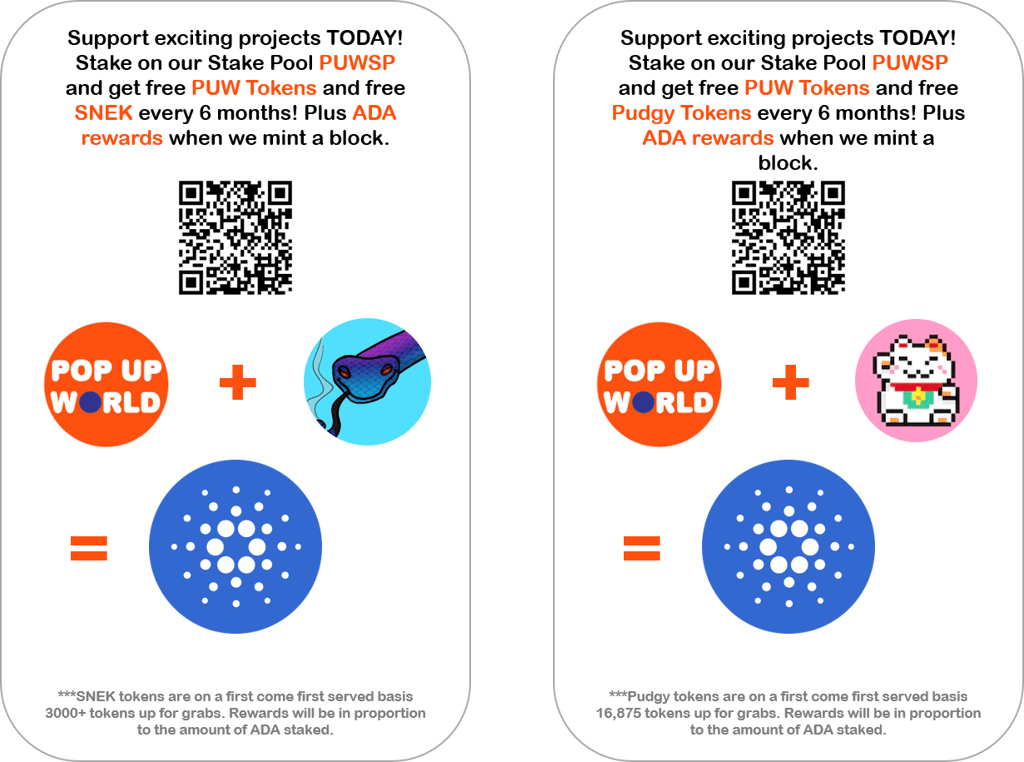
Earn and help support the Pop Up World Blog and entrepreneurs worldwide by joining our Pop Up World Stakepool! Go to https://popupworld.co.uk/popupworldstaking
Thanks!
Want to learn how to stake on Cardano? Read this article:
It starts with an idea. Pop Up World is a platform that helps start-ups and small businesses reach for the stars. No matter what size you are. Use our start-up guide Business Zero to Superhero, Design your Logo. Connect with investors via our Investor Connector. You can start a Website and Domain name. You can Search for and promote your Premises. You can promote your idea for free on our Pop Up World Ads site, you can even form a Limited Company You can also join us on our journey via the Pop Up World Token (PUW).

