
Cardano and its native token (ADA) is one of those cryptos that has historically always been in the top ten of cryptocurrencies, but recently, the shine has been rubbed off this asset. But is it really all doom and gloom?
With the recent shutdown of Cardano’s once popular NFT marketplace app, JPG Store and the closure of leading token analytics app, TapTools, this week (beginning of June 2026), things are not looking so bright.
The community is also in turmoil over various governance and voting issues relating to the future funding of the chain and various research projects.
As a result of heated internal wrangling, the Cardano Summit 2026 was cancelled due to the community vote not reaching its target.
There’s been a lot going on with Cardano.
In this article, we aim to take a balanced look at the state of the Cardano (ADA) ecosystem; the good, the bad and the ugly.
Please bear in mind that this article is not aiming to bash any project or individual.
All statements made are our personal opinion, based on our personal experience or based on verifiable facts.
For transparency, we run a live Cardano project Pop Up World token (PUW) and have been active in the Cardano ecosystem since 2020.
Here goes…
For more information on Pop Up World Token read this article:
The Good

Zero Downtime
The first thing to discuss is what’s good on Cardano; it’s not all doom and gloom!
As discussed, Cardano has historically always been in the top ten of cryptocurrencies, while that position has slipped recently (current top 15), Cardano’s blockchain technology is one of the most reliable in the industry.
Cardano boasts a long stretch of network uptime, with zero downtime since its inception in 2015.
This stat alone proves that Cardano is a robust blockchain to build on.
Determined and Experienced Founder

Cardano was founded by ex-Ethereum co-founder Charles Hoskinson in 2014.
Hoskinson gets a lot of flak from many, both inside and outside of the Cardano community.
However, it should be remembered that Hoskinson launched and grew Cardano from nothing to an 8 billion dollar market cap cryptocurrency.
That level of experience and knowledge is hard to come by.
Hoskinson’s experience from early Ethereum and Cardano gives the blockchain a solid level of leadership and experience to build on.
Hundreds of Interesting Projects
The Cardano ecosystem boasts hundreds of interesting and diverse projects. From Wallets, Digital Finance (DeFi) projects, Launch Pads, Stake pools, and even meme coins.
https://www.cardanocube.com/cardano-ecosystem-interactive-map
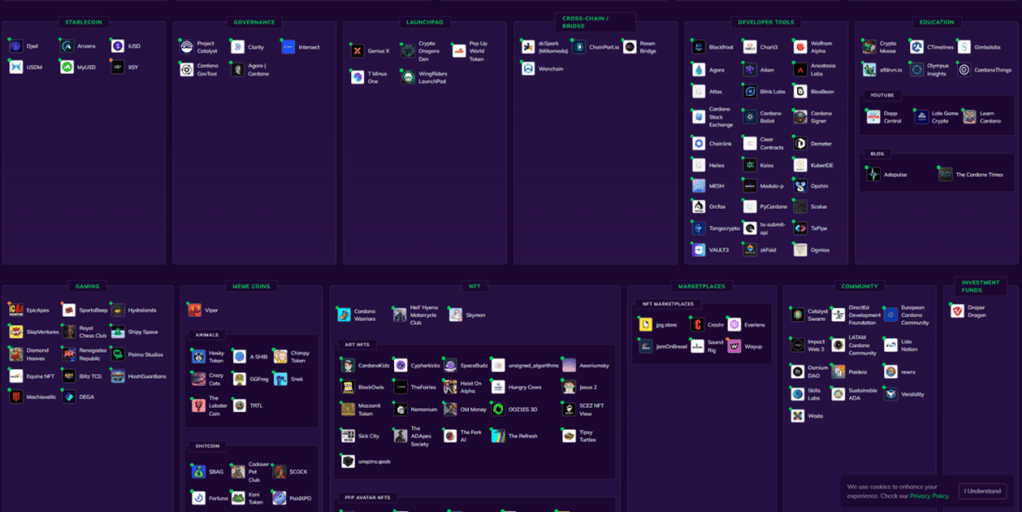
Despite the recent closures of major projects, JPG Store and TapTools, there are still hundreds of projects, both large and small, within the ecosystem.
Low Transaction Fees
Cardano has some of the lowest transaction fees in the industry. This makes it ideal for new builders with limited resources and for platforms dealing with multiple small transactions.
A Solid and Passionate Community of ADA Holders
Cardano hosts a passionate community of followers and ADA holders, all of whom dedicate their time and money to building and supporting projects within the ecosystem.
Many have been holding ADA for years and are fully committed and dedicated to the chain.
That level of loyalty is hard to come by, especially within the cryptocurrency industry, where any drop in price usually leads to ‘weak hands’ selling at the slightest hint of turbulence.
Genuinely Decentralised
While many blockchains boast of decentralisation, the recent governance and voting turmoil prove that Cardano is genuinely decentralised.
This is important because it means that proposals cannot be easily passed by an individual or entity (even the founder) without the consensus of the community.
While this could be viewed as a negative, it’s definitely a positive, especially during lean times, where extra checks and balances may be needed to preserve treasury funds or limit extravagant spending.
Current Macroeconomic Environment – Issues not with Cardano alone
While it cannot be denied that Cardano is facing significant headwinds, it should be noted that all cryptocurrencies are facing a difficult time during a challenging bear market.
At the time of writing, Bitcoin has crashed to below $63,000, Ethereum is below $1650, Solana is at $66, and Cardano sits just below $0.17.
While this is far from Cardano’s all-time high of around of $3.00, these figures show that all cryptos are suffering in the current climate, not just Cardano.
Therefore, it’s important to take a deep breath, pull back and look at the bigger picture during these tumultuous times. There’s a lot going on in the world outside of crypto.
Crypto is extremely volatile, and with that volatility comes large potential upside when things turn around.
Read this article on How to Not Lose Everything in Crypto:
The Bad

Hold on to your hats, get your popcorn, because now we’re going to take a look at some of the bad stuff.
Remember, our aim is not to bash. Cardano has many great features and a great community, but there is always room for improvement.
Here goes…
Project Catalyst Funding – Project Funding
On the surface, the premise of Project Catalyst was fantastic, a genuine game-changer.
A decentralised fund that would give money to viable projects voted for by the community.
The reality, unfortunately, was completely different. The decentralised nature of the voting allowed projects to vote on their own proposals.
In addition, voting power was linked to the amount of ADA held, leading to accusations of power imbalance.
Some judges had connections with proposals in the running, highlighting possible conflicts of interest.
Anonymous commenting allowed genuine projects to be targeted with unfounded ‘scam proposal’ accusations from competing members of the community.
The application process was lengthy and unwieldly; all proposals were public and open for all to view on the web.
The process was certainly not that welcoming to newcomers to the Cardano ecosystem.
Many proposals received scathing public attacks. Many of these projects are seemingly never to return to Cardano ever again. Not great optics or marketing for Cardano.
Many projects that received funding never delivered on their promises or folded soon after receiving funding.
Many funded projects had no path to self-sustenance or profitability, just reliance on continual grant funding.
In February 2026, Cardano announced that it was suspending Project Catalyst Funding rounds 15 and 16.
Some speculate that this was due to the guaranteed selling pressure on the price of ADA once the grant distributions were made during a bear market.
But there were many issues with the Project Catalyst funding process prior to this.
Unfortunately, a funding mechanism with genuine promise did not take into account human nature and the inherent greed within the crypto space.
Read this article on how short-term thinking and greed can end your business:
Lack of Project Support – No Native Token Support
Launching your project or token is a rather technical exercise, but it’s not that difficult. There are now apps within the Cardano DeFi space that allow you to mint your own token easily.
However, surprisingly, Cardano does not actively promote native tokens. There is no onboarding, no ‘welcoming party’. Nothing.
Yes, some platforms such as Snek (SNEK) are now attempting to run a Solana-type Pump.fun minting and promotion, mainly for fledgling meme coins.
But the organisation and many of the decentralised exchanges (DEXs), only list or give visibility to “verified tokens”.
This creates a barrier to entry for wannabe projects due to the fees and time associated with the verification process.
Yes, there are genuine concerns that some new projects could be ‘scams’, but the main purpose of a DEX is to ensure that anyone can list a token freely.
Cardano is supposed to be decentralised. There should be no human gatekeeping in that process.
Cardano as a whole seems to be suspicious of any new project, and this is a genuine barrier to entry for entrants to the ecosystem.
If the ecosystem requires more users and builders, it should seek to welcome new entrants appropriately. It should not treat them as threats.
Getting listed on wider marketplaces such as CoinGecko or CoinMarketCap is a challenge given these circumstances, especially for smaller projects due to the lack of market penetration of Cardano native tokens in general.
This lack of support makes it virtually impossible for Cardano native tokens to make the jump from DEXs to Centralised Exchanges (CEXs) or get listings on established crypto exchanges such as Binance or Coinbase.
In fact, to date, the only Cardano native token aside from ADA that has been listed on a major centralised exchange is Cardano’s own privacy token, Midnight (NIGHT) launched on Cardano in Dec 2026 and subsequently launched on Binance on 31 March 2026.
In practice, this means there is no defined pathway for substantial growth for any Cardano project unless it is run by Cardano.
Even some of the largest projects on Cardano are struggling to raise awareness in the wider crypto community outside of the Cardano bubble.
This is a big loss as a whole for Cardano, since the exposure of listing on a centralised exchange is where the big opportunities and brand awareness lie.
In addition, small or new Stake Pool Operators (SPOs) have no established mechanisms or support to raise awareness of their stake pools.
Therefore, if they cannot attract delegators, they will not be able to provide rewards and will eventually close.
Read this article on Staking On Cardano:
Suspicious Minds

As discussed already, Cardano does seem to be overly suspicious of newcomers.
One prominent Cardano influencer has the words “Beware of Scammers” in his X (Twitter) Bio.
Valid advice, maybe, but certainly not good optics and marketing to potential new users to the ecosystem.
It’s ironic that in 2021, prior to Cardano having a functional DEX, a Swiss team (MuesliSwap) beat the established Cardano ‘favourite’ (SundaeSwap) to the post in launching the first DEX on Cardano (Nov 2021).
The resulting cries of ‘scam’ and numerous accusations followed the Swiss team.
In reality, it was later found out that the ‘favoured’ SundaeSwap team had been in dispute with a business partner due to fraud accusations.
It was alleged that SundaeSwap had reneged on a pre-launch deal with the platform CardStarter over a disputed 150 Million Sundae Tokens.
While the dispute was later settled, it certainly left a bad taste in the mouths of the community and negatively impacted the launch of SundaeSwap.
The takeaway here is that it’s impossible to prejudge where the bad actors are likely to be.
The paradox for Cardano is that, as a decentralised blockchain, new users are the lifeblood of the network, and transactions should be permissionless.
Yet newcomers are often hindered from transacting on the chain via suspicion, manual processes, additional fees and human verification processes.
Read our original article on MuesliSwap here:
Ghost Chain Accusations

Some outside of the Cardano community have criticised Cardano for being what is termed “A ghost chain”. Essentially, a blockchain where nothing is going on.
As already established in this article, Cardano has hundreds of projects across all categories, so the claim is technically unfounded.
However, when Cardano is viewed from the standpoint of an outside observer, it becomes clear why this false accusation could appear to be valid.
We list 6 reasons why the ‘Ghost Chain’ false accusations persist:
Reason 1. No Native Token Presence – As stated already, Cardano has no native token presence in the wider crypto community (apart from ADA), despite having hundreds of active projects.
This lack of new, exciting tokens for new users to support may give the impression that ‘nothing is happening’ on Cardano.
Exciting new tokens are only available within the Cardano ecosystem; in addition, these new tokens need to be ‘verified’.
Reason 2. Limited Marketing & Promotion – Cardano has little marketing and promotional reach outside the Cardano ‘bubble’.
Cardano is not venture capital backed, therefore it has not spent resources on promotion, sponsorships and marketing to help push the brand to the wider crypto community.
Much of Cardano’s marketing is organic. Which is great, but other chains have more visibility in the industry.
Reason 3. Cardano Price – While Cardano has reached all-time highs of $3.09 in the past (2021) the price of ADA has been viewed by many as lacklustre. In an industry where huge gains and volatility are the norm, ADA has been viewed as steady.
While Cardano staking is a great feature, it means many Cardano users do not transact with their ADA. Cardano has a fantastic feature whereby staking does not require users to lock up their ADA for any period of time.
However, despite this innovation, ADA is not being circulated within the ecosystem. This results in low transaction fee revenues, limited token buys, minimal paid registrations and limited platform fees for projects.
When viewed from the outside, this lack of transacting could be easily viewed as inactivity.
Also, despite millions of dollars in stake pools and other project pools (estimated 80 billion ADA), this value is not calculated in TVL (Total Value Locked) figures, as these funds are uniquely liquid on Cardano and not locked within smart contracts.
This leads to a lower TVL figure in comparison to other chains where staking is locked and held in smart contracts.
Reason 4. Lack of Excitement or Buzz – Cardano’s focus has been primarily research-based and technical. This is a valid approach, but the industry as a whole relies on buzz and excitement.

Cardano has struggled to bring genuinely exciting products to market. Many of Cardano’s largest projects are functional and have utility, but bring nothing that will genuinely entertain or get the wider industry users excited and talking.
Reason 5. Lack of a Cardano ‘Champion’ – People love to back a big personality. Bitcoin has Michael Saylor, and Ethereum has Tom Lee. Cardano has…no champion.
The champion cannot be the founder; it has to be someone who is an outsider and passionate about the chain.
The champion buys relentlessly despite volatility. When times are good, the champion will lap up the credit and adulation; when times are bad, the champion will absorb the criticism.
Some may argue that a champion can cause more harm than good by consolidating tokens into fewer hands, but that is for the community to decide whether this approach suits Cardano or not.
The lack of a Cardano champion certainly can give the perception that ‘nothing is happening’ with Cardano.
While the ‘ghost chain’ accusation is technically false, the above highlights how perception is everything in crypto.
Reason 6. ‘Elite’ Mentality and ‘Insider’ Based Hierarchy

Cardano’s appeal is that it’s rigorous and is based on scientific research. While this makes practical sense, it does unfortunately give the blockchain a rather ‘elite’ image.
Many within the Cardano community are hyper-focussed on technical capability and infrastructure upgrades, which is fine, but it is of no use if new users are not flocking to the chain to utilise the top-grade architecture.
There is no denying that Cardano is one of the most robust and secure chains in the industry; however, this seems to have bred an air of superiority and complacency that may be intimidating to newcomers.
New users who may lack technical prowess but may have great ideas may be intimidated by Cardano’s focus on the technical.
As we enter the era of no-code and AI-coded platforms, Cardano will have to adapt and accept that competitors will be using these tools to ship exciting new products quickly, often without expensive development teams.
While Cardano is genuinely decentralised, there is a tendency for some in the community to revert to behaviours that blockchain and decentralisation were supposed to eliminate.
A prime example of this was the Project Catalyst issues mentioned previously, where ‘insider’ projects were funded multiple times, some with little or no return on the investment.
Many smaller projects felt frustrated that their projects were denied funding while other ‘insider’ projects obtained funds, even though no progress had been made with the ADA received from previous funding rounds.
Most recently, a small number of seven Cardano ‘influencers’ put forward a proposal for 1.5 million ADA for ‘marketing’ from the Cardano treasury.
The proposal caused a lot of heated debate and backlash, with some community members arguing that the proposal funds should be open to all marketers within the community, not just the seven ‘elite’ influencers.
These two examples highlight that while Cardano is genuinely decentralised, there is sometimes a leaning towards hierarchy and insider behaviour from some members of the community.
While this probably is not intentional, the lack of awareness of the issue is very apparent.
This behaviour, whether intentional or not, does not look appealing from the standpoint of a new user or builder looking to enter the ecosystem, an investor looking to invest in Cardano projects, or even an institution looking to base its established reputation on the Cardano blockchain.
In addition, Cardano appears to lack systems to prevent this type of behaviour.
Read this article on Insider Groups, Cabals and Monopolies.
The Ugly

Ok, so we got the ‘bad’ stuff out of the way.
As stated previously, Cardano has much going for it, and despite its flaws, these ‘bad’ issues are all potentially solvable, and we will look at some possible solutions later.
But first, there are a few problems that appear to be rather unique to Cardano; those issues are public infighting, name-calling and emotional outbursts.
Let’s take a look at the ugly underbelly of Cardano.
Here goes…
There are some within the Cardano community that have no problem hurling abuse, calling other Cardano projects ‘trash’, public name calling, often with expletives and borderline questionable communication, usually on X(formely Twitter).
While Twitter is a platform that allows ‘free speech’, some within the Cardano community push ‘free speech’ to its limits.
For whatever reason, the posters of these comments don’t seem to realise that their posts are visible, not only to the Cardano community, but to everyone worldwide.
While passionate, heated debate and constructive criticism are healthy and useful, name-calling, bashing and character assassination are not.
This alone is a serious risk to Cardano. The negative and public self-sabotaging that some seem intent on inflicting on the ecosystem is potentially a greater threat than the sum of all the ‘bad’ points mentioned previously.
It simply needs to stop.
The Solution?

Ok, so we’ve looked under the carpet and decided not to sweep the bad and ugly stuff under it? So what now?
It should be noted that the issue is complex and there is unlikely to be a ‘silver bullet’ that fixes everything.
Here are some suggestions that may help.
Here goes…
Step 1. The first thing Cardano needs to decide is whether it’s targeting institutions or retail investors.
Institutions will require the robust system architecture and transaction speeds that Cardano has built. The scientific research-led growth will suit perfectly.
If Cardano genuinely wants to persuade institutions to use the chain, this approach is a bare minimum.
Retail investors (the general public) demand exciting new token launches, entertainment, opportunities for quick wins and a convincing narrative.
Retail investors are also becoming increasingly savvy and are looking for projects with genuine revenue potential.
Projects that rely on a meme or cartoon character alone are becoming increasingly less popular. Retail investors are wary due to the cryptocurrency industry’s history of ‘rug pulls’ by such projects.
They are not looking at scientific papers or transaction speeds; as long as it works and is good enough, it’s fine.
At the moment, Cardano is caught between two stools and faces difficulty navigating both.
Pursuing scientific research without concern for future financial sustainability is unfortunately no longer viable.
This is compounded by financial factors such as the reduction in treasury funds, the reduction in transaction fee revenues and the reduction in the ADA price.
A decision needs to be made whether to prioritise one or the other. Doing both is feasible, but there has to be a priority. The community will need to decide accordingly.
Step 2. Repair Project Catalyst – Project Catalyst was a great funding mechanism, as discussed earlier. But it needs to be repaired.
All Cardano projects need support, both small and large. If Cardano’s main aim is to attract mass adoption from retail, then support for small projects is essential.
This could involve providing one-off seed capital to brand new projects and teams to entice fresh builders and ideas to Cardano.
Any seed funding should be one-off, unless the project has shown tangible growth and revenue, not just hype from the capital invested.
The application and funding process should be simplified, so the barrier to entry for new entrants is minimised. No lengthy applications and timeframes. Minimal red tape.
The voting process should be minimised. Cardano holders should not be allowed to vote on their own or associated projects.
Systems should be put in place to prevent ‘gaming’ the system.
In addition, while voting results should be made public, comments and criticism of projects should not be made public.
Step 3. Improve Project and Native Token Support – If Cardano’s goal is to attract mass adoption, it will need to improve native token support for new builders and teams.
Cardano should look at including an onboarding option for new builders.
Cardano should consider offering incentives to build on Cardano, whether that be launching a token, launching a stake pool or a fully blown DeFi project.
All builders should be respected and welcomed appropriately.
A central point where newcomers are welcomed and rewarded for their effort is probably essential.
The culture of suspicion of new projects and ideas has to end.
Even established venture capital firms with decades of experience find it difficult to predict ‘winners’ (90% of start-ups fail); therefore, Cardano should not even attempt to do this, and should simply allow the cream to rise to the top.
Step 4. Genuine Marketing and Business Development Efforts – If Cardano wants to attract retail investors, it will have to invest significant sums in genuine marketing that has the reach required to make a difference.
In practice, that may mean highly visible sponsorship deals, advertising to their core audience via various online platforms and a defined social media strategy.
Unfortunately, YouTube influencers alone will not be enough.
If Cardano also wants to go down the institutional route, a Business Development arm will be necessary to target institutions, enterprises and governments effectively.
One strategy alone is unlikely to work; a marketing mix will more than likely be required.
Read this article on a Marketing Mix:
Step 5. Public Image – If Cardano wants the marketing highlighted above to work, it will need to pay close attention to its perceived image from the viewpoint of a dispassionate observer.
‘Elite’ messaging may work for institutional adoption, but may drive away retail investors who require simplicity, entertainment and fun.

The toxic public attacks and name-calling have to stop. The suspicious mindset of ‘everything’s a scam’ has to end.
Leaving X(Twitter) is not the solution. Better behaviour by all is the only solution.
Blaming X(Twitter) for bad behaviour is not the solution. All publicity is good publicity; it’s how you deal with it that counts.
Retreating into a private forum will only breed the ‘elite’ mindset further.
The elite mindset, insider mentalities and internal hierarchies also need to end. This is absolutely necessary if mass adoption and retail users are required to drive growth.
If institutions are the main driving force, the elite mindset may be appreciated. However, ethics, professional conduct and reputation will be put under scrutiny by any institution looking to partner with Cardano.
Step 6. Cardano May Need A Champion – Cardano may need someone with deep pockets to ‘champion’ the chain. Think Michael Saylor for Bitcoin and Tom Lee for Ethereum.
The champion should not be the founder or directly associated with Cardano.
The champion may be required, whether retail or institutional users are targeted and will help drive the visibility of the Cardano project outside of the Cardano ‘bubble’.
Step 7. Cardano Needs to be Exciting! – If Cardano wants to attract mass adoption from retail, it will need to be fun and exciting.

This is not so essential if the aim is to target primarily institutions.
If Cardano manages to onboard exciting new projects, attract media interest and new user adoption, the associated buzz and interest should eventually crystallise into positive price action.
Increased price action will lead to more buzz and more users; it’s a virtuous cycle.
It should be noted that this will probably be the most difficult part for Cardano to execute.
Buzz cannot be manipulated artificially forever. Real buzz comes from genuinely exciting products, tokens and teams making a difference in the real world.
This kind of excitement cannot be faked. Therefore, Cardano should ensure it has the mechanism to foster and grow promising and exciting projects from the start.
What do we mean by exciting? It’s probably easier to say what’s not exciting;
A new analytics platform, a new infrastructure upgrade, a new technical feature, a new Decentralised Exchange (DEX), or a new digital wallet are all necessary, but are not exciting from the viewpoint of the retail user.
There should be a separate track of funding for these essential, but less exciting projects, especially if retail adoption is the target audience.
Cardano should not allow short-term thinking to drive funding decisions without the requirement to evaluate the impact on the Cardano community as a whole.
Of course, essential projects should usually be funded, but the long term benefits should be clear and economic viability should always be part of the decision-making process.
This should be clearly communicated in an unbiased way, so appropriate voting decisions can be made by the community.
Step 8. The Cardano Community Needs to Transact – As mentioned earlier, Cardano has a loyal and passionate community of holders.

However, there is an issue with the community that, if overcome, could probably solve most of the major issues overnight.
The issue is that the community is not using their ADA to transact.
While community members are engaged on X (Twitter), that engagement does not translate into token buys and on-chain transactions. This makes it very difficult for any project, large or small, to be sustainable.
What this means for projects is a lack of revenue, no growth and a lack of interest from those outside the Cardano ‘bubble’.
It does not matter how good a project is, if there are no fees generated, tokens bought or registrations paid for, the project will eventually fail.
Cardano is estimated to have over 4.6 million wallet addresses as of 2026. Of these, an estimated 1.3 million are participating in staking.
Cardano is unique in that staking does not require the user to lock up their funds at all. So there is no technical reason why the Cardano community members cannot transact.
So why the issue?
Well, we can only speculate, but it appears from community posts online that many community members have bought ADA many years ago, staked it, and are simply waiting for the price to go up.
Many have put life savings or significant sums into ADA, and they are literally sitting on their hands waiting for price action, in order to take profits.
Unfortunately, things are not that simple. Without genuine project growth and token buys, Cardano will languish, and their investment will eventually dwindle.
Real growth requires not only community engagement vocally online, but also community action with real, tangible funds.
For example, let’s say there are 50,000 community members who are prepared to invest $10 into a new and different Cardano project each month.
They could do this by buying the project’s token, registering on the project site for a fee, or transacting via the project protocol so the project can make a fee.
That would mean the project would make 50,000 x $10 = $500,000 in revenue, literally overnight.
$500,000 in Revenue generated per project, overnight from 50,000 community members, with just a $10 investment!
But in reality, community members go ‘all in’ on the ‘top’ projects, and once bought in, they are forced to sit on their hands until the price goes up to take profits.
Of course, in the current climate, the price does not go up; it plummets, and therefore, community members get frustrated and disgruntled with their investments and Cardano as a whole.
We can already hear the cries of “What if the new project fails?” Well, as stated previously, 90% of start-ups fail, so it should be expected that a large proportion of these ‘speculative buys’ will fail too.
This should be viewed simply as a cost of doing business, since a percentage will succeed that will make up for the losses.
However, looking at the bigger picture, each community member will only lose $10 per new project invested in. No life savings lost, no major upset, just move on to the next viable opportunity.
So, Cardano needs to find a way to encourage community members to invest in a diverse range of smaller projects regularly with smaller investments rather than the ‘all-in’ mentality that appears to persist.
If Cardano could solve this problem, the ecosystem could potentially boom relatively quickly, and ironically this could remedy the price action issue and low transaction fee revenues, too.
Cardano is in a very unique position of having a loyal and passionate community.
Community members need to take action to use that latent power to create change by supporting smaller projects so Cardano as a whole can prosper.
Is Cardano Dead?

OK, so we’ve gone over some potential solutions, but we’re sure there’s a nagging question in the back of your brain: “Is Cardano Dead?”
Well, in order to answer that question, we need to look at the facts.
What exactly has changed? Has anything fundamental occurred that makes Cardano unviable?
A couple of projects have shuttered their doors, yes. The price has plummeted, yes, but every cryptocurrency has that same issue, not only Cardano. Projects fail all the time, this is not unique to Cardano.
Cardano has issues with community transactions, voting and governance issues, yes. However, all the issues are potentially solvable.
In essence, nothing has changed with regard to Cardano’s potential.
All these issues are real, but fundamentally, Cardano has a solid foundation. There is a reason it has remained in the top ten of cryptos for many years.
However, we do need to be realistic; there is some risk.
As with all cryptocurrencies, there is a risk that if market conditions persist, Cardano could collapse and go to zero or near zero. Especially if Cardano fails to take action on the points raised in this article.
It’s unlikely, but the risk is there. However, the same risk applies to all cryptocurrencies in the current climate.
So, the answer to the question is no, Cardano is not dead.
However, it’s in the hands of the community and the figureheads of Cardano to ellicit real change to make Cardano a thriving ecosystem fit for projects large and small.
Read this article on “Why is Everything Crashing?”:
Final Thoughts

While the current climate of uncertainty breeds fear and doubt. Cardano has many good features to offer.
It offers a reliable backbone, secure and fast transaction speeds, and has uptimes that many other chains should envy.
It also offers a diverse range of hundreds of genuine projects and a loyal and passionate community of ADA holders.
No doubt, there are issues: a lack of reliable funding for new projects and the issues surrounding the pausing of Project Catalyst, highlighted in this article.
There are also inherent issues with native token support and the general suspicion of new innovative projects within the Cardano ecosystem.
There are also issues with regard to ‘insider’ favouritism and potential conflict of interest issues.
The worst issue of all is the public personal attacks, name-calling and toxic vitriol that is exuded by some members of the community online. This behaviour simply has to stop.
There is also the major issue of low transaction activity by community members, which makes it difficult for projects both large and small to generate sustainable revenue.
However, all the issues raised are solvable.
Despite the current climate and fall in the cryptocurrency markets in general. Cardano certainly is not dead.
However, there are risks.
If the current macroeconomic climate persists and Cardano does not solve the toxicity issues, project funding issues and the lack of community engagement transaction-wise, it cannot be denied that there is a risk that the Cardano project could fail.
We’ve shown in this article that even if a relatively small portion of Cardano members, say 50,000 out of the 4.6 million wallets, were to invest just $10 into a new project each month, each project could earn 500,000 dollars in revenue overnight.
Cardano has the community and the loyalty to make that difference.
The question is, is the community prepared to put individual interests aside and take action to make the change a reality for the benefit of themselves and the entire Cardano ecosystem as a whole?
The going ‘all in’ on large projects and sitting on inactive stake pools mentality needs to change.
Cardano is like a doctor who is trying to keep a sick patient alive. The doctor decides to route all the blood flow to the brain to keep the patient going. However, without blood flow to all extremities, the hands, the fingers, the toes, and of course, the heart, the patient will atrophy and eventually die. The brain needs the body to survive; it cannot survive all by itself.
Are you prepared to make a change today?
Good luck!
***Disclaimer: This article is not financial advice and is given for informational and entertainment purposes only. Readers should conduct their own research and not invest more than they can afford to lose. Crypto is extremely volatile, and as such can drop in value considerably without notice. Pop Up World has a global presence and is not specifically targeting any jurisdiction with its content. Any crypto references are not intended for UK businesses or consumers. You should always seek legal advice to understand if the use or investment in crypto is allowed in your jurisdiction.
Get the token on Cardano Decentralised Exchanges (DeXs), MuesliSwap, SundeSwap, Wingriders and Minswap. Or click the link here:
Pop Up World YouTube Reviews:
Review. Malik Atif – Hindi -Urdu
Review. Inside Crypto – Hindi – Urdu
Review. Convincing Crypto – English
The Pop Up World Token is designed specifically for entrepreneurs, to store value and to utilise on our platform Pop Up World. Join the revolution in financial freedom today.
Thanks!
Pop Up World – Merchandise – Click here.

***Disclaimer: This article is not financial advice and is given for informational and entertainment purposes only. Readers should conduct their own research and not invest more than they can afford to lose. Crypto is extremely volatile, and as such can drop in value considerably without notice. Pop Up World has a global presence and is not specifically targeting any jurisdiction with its content. Any crypto references are not intended for UK businesses or consumers. You should always seek legal advice to understand if the use or investment in crypto is allowed in your jurisdiction.
It starts with an idea. Pop Up World is a platform that helps start-ups and small businesses reach for the stars. No matter what size you are. Use our start-up guide Business Zero to Superhero, Design your Logo. Connect with investors via our Investor Connector. You can start a Website and Domain name. You can Search for and promote your Premises. You can promote your idea for free on our Pop Up World Ads site, you can even form a Limited Company You can also join us on our journey via the Pop Up World Token (PUW).

