
It’s well known that the growth of AI has created a huge demand for resources. The success of AI has led to an issue. That issue is power.
The power drain of Graphical Processing Units (GPUs) used to crunch the numbers for AI can consume hundreds of watts per device. But what if there’s another way?
AI pioneers like Elon Musk have suggested the creation of huge data centres in space; others like Sam Altman (OpenAI) have called this idea “ridiculous”.
In this article, we look at an alternative that could potentially solve the issue.
Here goes…
The Problem

As AI models grow larger and user engagement has increased, the power requirements to train them have increased dramatically.
In addition, the increased demand for GPUs and memory requirements (RAM) has also seen increased costs.
The issue is compounded by the fact that the immense processing capability needs to be kept cool to avoid meltdown, which also requires additional power for cooling.
So, there lies the problem. As AI becomes ever more successful and as more people want to use it, the power and resource demands also grow.
Potentially, this could mean an ever-increasing cycle of energy demands on power grids and on the world’s electronic supplies and memory chips.
The problem cannot be underestimated.
AI pioneer Elon Musk has suggested the development of space-based data centres that could harness the sun’s energy for ‘free’ solar power.
This solution could ‘kill two birds with one stone’ and potentially solve the ‘cooling’ problem, since space can be extremely cold, offering ‘free’ cooling as a bonus.
However, detractors such as Sam Altman have called the proposal by Musk ridiculous.
Altman states, “I honestly think the idea with the current landscape of putting data centres in space is ridiculous.”
“It will make sense someday, but if you just do the very rough math of launch costs relative to the cost of power we can produce on Earth, not to mention how you are going to fix a broken GPU in space, and they still break a lot, unfortunately, we are not there yet.”
He may have a point, but what if there’s another way?
The Solution
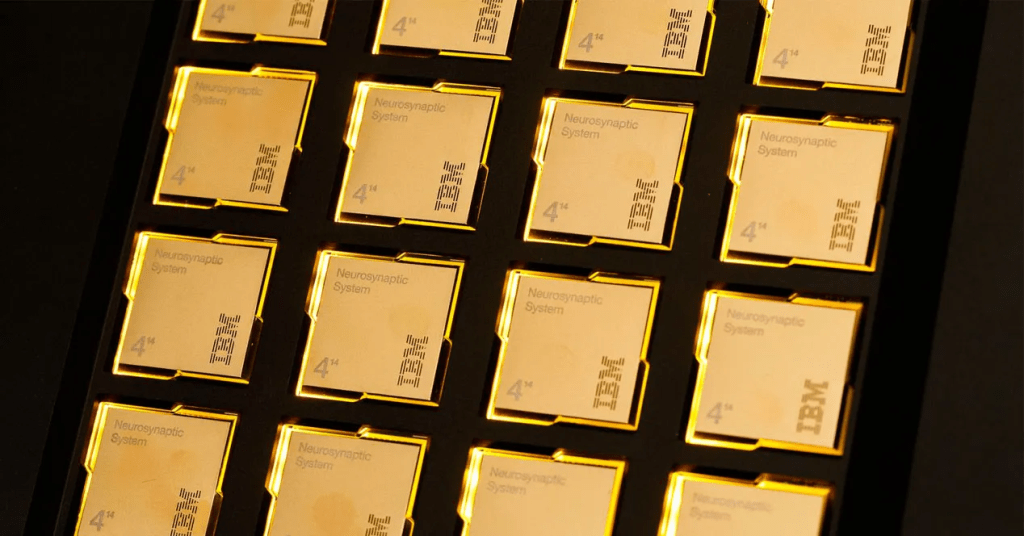
To find a potential solution, we need to go back in time to the early 2000s.
In 2004, IBM laid down the specifications for TrueNorth, a specialised computer chip. The chip was officially announced in August 2014.
The TrueNorth chip works on the basis of “Neuromorphic Computing.”
In simple terms, neuromorphic computing operates by attempting to mimic the physical operating principles of biological brains.
The advantage of taking such an approach means that the computational requirements and, therefore, power requirements for this new architecture are much reduced.
For example, the human brain can perform complex tasks such as vision, language and learning, while consuming very little energy, estimated at around 20 watts of power.
It may sound like science fiction, but what if computers were built more like biological brains?
Science Fact, Not Science Fiction

Although the concept may sound like sci-fi, it’s clearly not.
IBM’s TrueNorth chip was developed and funded from 2008-2016 under the U.S. Government’s DARPA’s (Defence Advanced Research Projects Agency) “syNAPSE” program.
Rather than executing instructions one by one in sequence, TrueNorth consists of a large number of small, independent processing units called neurosynaptic cores.
Each core operates much like a biological brain with digital recreations of “neurons” and “synapses”.
This architecture simulates how our own brain works via communication with electrical spikes between neurons and synapses.
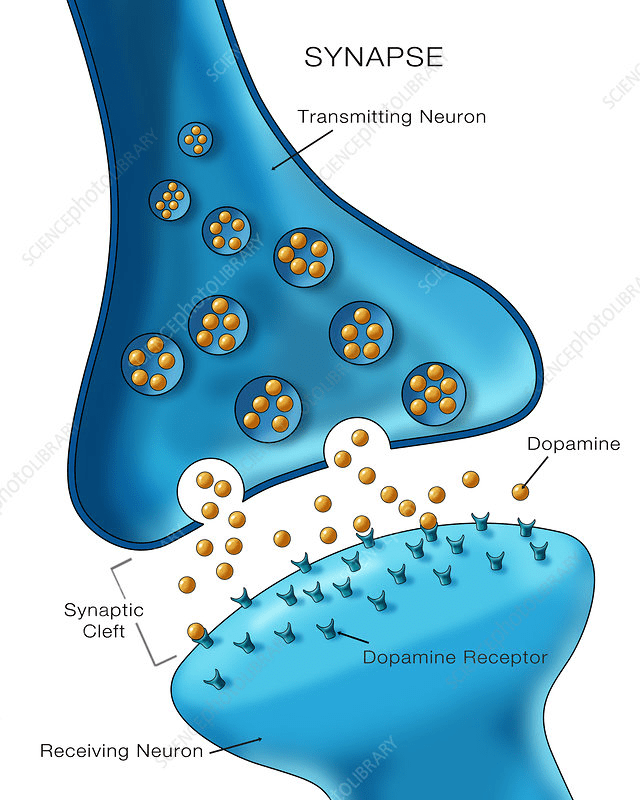
The radical plan required the creation of a chip containing millions of neurons.
The eventual goal was the creation of a multi-chip robot and eventually “human-level” capabilities.
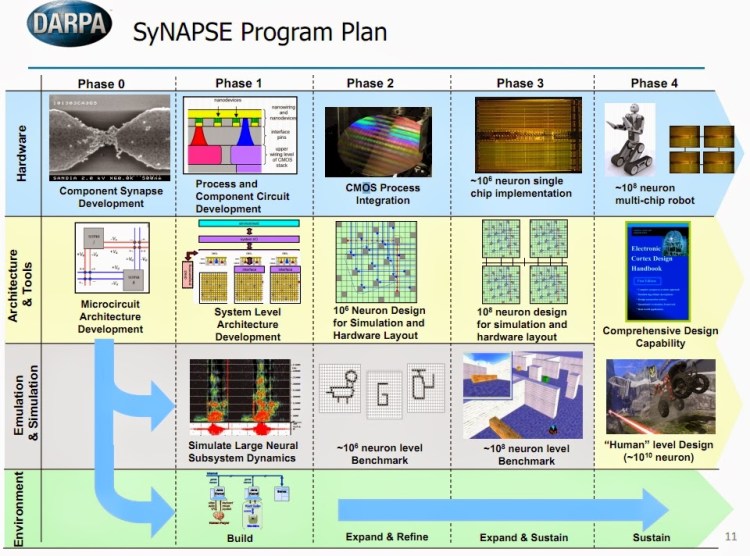
It’s important to note that the program was a publicly funded program and not classified.
The program led to the successful creation of a functional chip.
A single chip implemented around one million artificial spiking neurons and 256 million synapses, while consuming only tens of milliwatts.
The system was scaled to a multi-chip design that contained tens of millions of neurons with power consumption far below that of the GPU-based systems that are popular today.
In terms of energy efficiency, TrueNorth type systems can be 10 to 1000 times more energy efficient than GPUs.
What Does It All Mean?

In essence, computer systems built on neuromorphic computing principles could potentially eradicate the need for huge power-hungry data centres and the associated cooling problems.
Neuromorphic chips remain mostly idle until a spike occurs. If there’s no spike and no neural activity, the system consumes almost no power.
Conversely, GPUs that are in use today are clock-driven and are in a perpetual state of synchronised cycling, whether data is present or not.
The power consumption and cooling requirements for systems based on the neuromorphic principles would be much more efficient for real-world AI workloads.
So, What Happened?

Despite functional chips and years in development, the project is generally considered “research-focused” and was not developed into an active commercial product, despite its promise.
According to DARPA’s own program page, the SyNAPSE entry is labelled “This program is now complete” and the page is no longer actively maintained.
The ‘proof of concept’ has since been developed into newer neuromorphic chips and research, such as IBM’s NorthPole that maintain all the efficiencies of the original system.
Despite all the advantages, GPUs still remain superior when it comes to dense numerical workloads.
Also, developers would potentially need to create and learn new programming languages to take advantage of such systems.
However, this does not diminish the importance of neuromorphic computing.
A combination of neuromorphic and GPU processing could offer the ‘best of both worlds’ with the associated energy efficiencies.
Opportunities For Entrepreneurs

Entrepreneurs looking to invest in traditional GPU technology would be wise to look into the potential of neuromorphic computer chips.
The technology has been around for some time and is tried and tested. A robust consumer chip is all that is needed for potential large-scale adoption.
As power demands grow, neuromorphic technology may be the answer to reducing the power demands for AI.
Entrepreneurs could also benefit by creating new programming interfaces for the new tech, making it easier to integrate into existing computer architecture.
Entrepreneurs in the computer science fields could do extremely well in future if their focus is on power-efficient alternatives to the current paradigm, possibly with neuromorphic chips at the core.
Final Thoughts
As the demand for AI increases, so does the need for energy.
On the current path, those energy demands could be overwhelming for an already overloaded electrical grid.
By harnessing the power of artificial “neurons” and “synapses”, the technology could be utilised for use cases where ‘always on’ capabilities and low energy consumption are paramount.
Neuromorphic computing could potentially be the answer to creating energy-efficient AI that only consumes power when it is “thinking”.
Savvy entrepreneurs in the computer science fields could do especially well in future by following the neuromorphic computing path.
Technical entrepreneurs could do well in the creation of new interfaces and programming languages for the new architecture.
Entrepreneurs should be careful not to go ‘all in’ on the existing power-hungry GPUs.
However, it’s likely a combination of GPUs and neuromorphic technology will be needed in future due to mathematical processing needs.
It’s also possible that the demand for GPUs in future may not be as great as currently anticipated.
Technology like TrueNorth shows that the path to advanced AI may not lie in more energy consumption, but in quieter, more brain-like machines.
Are you willing to give it some thought?
Good luck!
Virtual Heaven (Back To Reality) 2017 – (Graham Jules)

Read about the full ‘Alien Agenda’ in an exciting Sci-Fi – Illustrated Screenplay Format Book – Limited edition copies available on Amazon. Virtual Heaven (Back to Reality) – by Graham Jules.
Pop Up World token has a growing ecosystem and is one to watch for the future.
***Disclaimer: This article is not financial advice and is given for informational and entertainment purposes only. Readers should conduct their own research and not invest more than they can afford to lose. Crypto is extremely volatile, and as such can drop in value considerably without notice. Pop Up World has a global presence and is not specifically targeting any jurisdiction with its content. Any crypto references are not intended for UK businesses or consumers. You should always seek legal advice to understand if the use or investment in crypto is allowed in your jurisdiction.
Pop Up World YouTube Reviews:
Review. Malik Atif – Hindi -Urdu
Review. Inside Crypto – Hindi – Urdu
Review. Convincing Crypto – English
The Pop Up World Token is designed specifically for entrepreneurs, to store value and to utilise on our platform Pop Up World. Join the revolution in financial freedom today.
Get the token on Cardano Decentralised Exchanges (DeXs), MuesliSwap, SundeSwap, Wingriders and Minswap. Or click the link here:
Pop Up World token has a growing ecosystem
Earn and help support the Pop Up World Blog and entrepreneurs worldwide by joining our Pop Up World Stakepool! Go to https://popupworld.co.uk/popupworldstaking
Thanks!
Want to learn how to stake on Cardano? Read this article:

It starts with an idea. Pop Up World is a platform that helps start-ups and small businesses reach for the stars. No matter what size you are. Use our start-up guide Business Zero to Superhero, Design your Logo. Connect with investors via our Investor Connector. You can start a Website and Domain name. You can Search for and promote your Premises. You can promote your idea for free on our Pop Up World Ads site, you can even form a Limited Company You can also join us on our journey via the Pop Up World Token (PUW).
 Pop Up World Blog