
In a landmark trade mark dispute, (2024) multi-billion dollar media company Marvel & DC Entertainments Inc, creators of Superman, Batman et-al, lost their trade mark “Superheroes”.
The case follows numerous battles with small entrepreneurs, in particular in 2014 Marvel and DC battled with author Graham Jules over the title of his book. “Business Zero To Superhero”. Jules, emerged victorious after Marvel & DC dropped their case due to ‘commercial reasons’. The final hammer blow came from another London creator, Scott Richold of Superbabies Ltd, who wiped the floor with the comic book giants and emerged triumphant following a US Patent and Trade Mark Office battle of wills.
The win is significant but what does it mean in real terms for entrepreneurs? In this article, we take a look at just that…
Origin Story of the “Super Heroes” Trademark

Before we delve into the impact on entrepreneurs we need to look at the origins of the trade mark.
Marvel and DC started out as bitter rivals in the comic book industry. Marvel renowned for comic book superhero characters such as Spiderman, Captain America, Iron Man and Hulk. While DC were best known for characters such as Superman, Batman, Wonder Woman and the Joker.
The trade mark SUPER HEROES was first registered in 1972 by Ben Cooper, a Halloween costume maker under licence to sell Marvel and DC costumes.
After numerous legal wrangles with Mego Corporation, a toy manufacturer, also licensed under Marvel and DC, Cooper handed over his trade mark, SUPER HEROES for his costumes to Marvel and DC.
Marvel and DC had been looking to trade mark their stock of comic book characters as licencing deals boomed. After further wrangles, Mego Corporation also relinquished their trade mark SUPERHEROES for toys to Marvel and DC . In 1977, Marvel and DC were assigned joint ownership of the trade mark.
The unusual ‘joint ownership’ element of the Marvel and DC trade mark has always been seen as a legal conundrum since the purpose of a trade mark is to indicate a single source of origination of a product not multiple sources of origination.
The joint ownership between two rival companies allowed Marvel and DC to prevent other comic book creators from profiting from the term “SUPER HEROES” without their permission. This would lead to many legal tussles with entrepreneurs across the world.
Understanding the Trade mark

It’s important to understand that Marvel and DC’s trade mark, “SUPER HEROES” doesn’t prevent people from using the word in non-commercial situations.
Problems arise when the term is used to market or sell products such as comic books, toys and films, as the joint owners would claim infringement of their intellectual property rights.
Any independent creators who attempted to publish works utilising the word “SUPER HEROES” would face stiff action from Marvel & DC legal departments, which has drawn further attention to the unfairness of the trade mark.
2014 – The Graham Jules Case
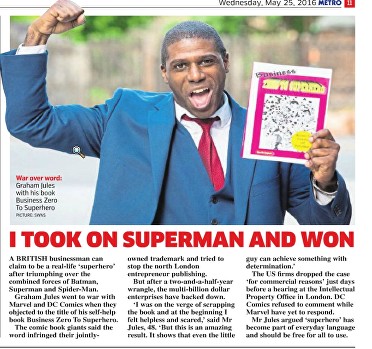
One of the most high-profile trade mark disputes involving the term “superheroes” occurred in 2014 when British author and entrepreneur Graham Jules found himself in a legal battle with Marvel and DC.
Jules had written a self-help book titled Business Zero to Superhero, a start-up guide for entrepreneurs. Jules had attempted to trade mark the title of the book when Marvel & DC sent legal opposition to his registration.
Jules, who was coincidently studying as a mature Business Law student resisted the opposition and after almost three years of legal back and forth he emerged victorious after Marvel & DC dropped the case, due to “commercial reasons”
Jules had argued that the term, SUPER HEROES had become a generic term used in every day language to describe all characters who possessed special abilities. He maintained that the use of the term for a self-help book would be non competitive in any case.
The case garnered widespread media attention, with many commentators questioning whether two U.S.-based companies should have the exclusive right to a term that had become deeply embedded in global pop culture.
After an extended legal battle, Graham Jules won his case in 2016. The UK Intellectual Property Office ruled in Jules’s favour, allowing him to continue using the term “SUPERHERO” in the title of his book.
This victory was seen as a significant blow to the efforts of Marvel and DC to control the term, especially outside the United States.
Jules described the victory as a win for small businesses and independent creators who should have the right to use common terms without fear of legal repercussions from corporate giants.
He used evidence based on other words that were once trade marked but later became too generic to enforce, such as “escalator” and “thermos.”
2024 – Marvel and DC Lose ‘Super Heroes’ Trade mark Due to Superbabies
Ten years following the Graham Jules case, Marvel and DC dramatically lost their long-held joint trade mark over the term “Super Hero” in 2024.
This decision came after a challenge from a small London-based comic book company called Superbabies Ltd, led by creator Scott Richold.
Again, the legal dispute centred on the argument that terms like “superhero” are generic and should not be subject to trade mark protection.
Richold argued that monopolising the term stifled creativity and harmed small businesses trying to tell their own superhero stories.
The U.S. Patent and Trade mark Office sided with Superbabies Ltd and Marvel and DC failed to adequately respond to court deadlines, leading to the cancellation of the trade mark.
It now means that any entrepreneur can utilise the word ‘Superheroes’ without fear of conflict from Marvel and DC Entertainment Inc.
The Impact of the ‘Superheroes’ Trade mark on Entrepreneurs

The case of Graham Jules exemplifies the broader issue of how the “Superheroes” trade mark affects independent creators and the publishing marketplace.
Marvel and DC have multiple millions to enforce their trade mark aggressively, smaller creators often lack the money and legal clout to fight back.
This would then force them to comply or risk expensive legal action that could be financially ruinous.
Many small publishers avoid using the term “Superhero” altogether, opting for alternative descriptions like “costumed vigilantes,” “metahumans,” or “powered beings” to sidestep potential legal issues.
The “Superheroes” trade mark raises broader questions about the monopolisation of language and creativity in the entertainment industry.
This dynamic creates a chilling effect, as smaller creators are restricted in how they can market their products within a genre that Marvel and DC dominate and stifles competition in the marketplace.
The victory of Graham Jules and his Business Zero To Superhero publication provided a glimmer of hope for independent creators.
His successful challenge in the UK opened the door to further debates over whether “superhero” should continue to be protected as a trade mark, or if it should be considered a generic term, available for all to use in creative and commercial contexts.
The successful challenge inspired other small creators such as Scott Richold and his Superbabies to also stand up to the multi-billon dollar Marvel and DC. This in turn lead to the eventual cancellation of Marvel and DC’s jointly owned ‘SUPER HEROES’ trade mark.
Final thoughts
The ‘Superhero’ trade mark highlights the levels of corporate control that exists in business today. Entrepreneurship is often stifled by the deep pockets of large multinational organisations who crush or buyout any competition in the marketplace.
On the positive side, cases like Graham Jules’ and the Superbabies show that David can sometimes and very rarely defeat Goliath.
To come out on top, the legal rules of the situation need to be examined carefully and the execution of your argument needs to be pinpoint and accurate.
No matter how large an organisation you are up against, if you are a brave entrepreneur and can accurately assess your chances, it’s possible to achieve the impossible.
This win is not just about ‘superheroes’, it’s a metaphor for all the struggling entrepreneurs, kept down by the establishment. Entrepreneurs who bravely battle, hope and dream to overcome the forces that keep them under, day after day.
How brave are you?
Good luck!
Read about the full ‘Alien Agenda’ in an exciting Sci-Fi – Illustrated Screenplay Format Book – Limited edition copies available on Amazon. Virtual Heaven (Back to Reality) – by Graham Jules.
Pop Up World token has a growing ecosystem and is one to watch for the future.
Let’s do something and help the homeless with the Pop Up World Homeless Card.
The concept is simple:
Step 1. Purchase some Homeless Cards and staple £20 or $20 to the Homeless Card.
Step 2. Place the Homeless Card with the attached funds in your pocket or purse.
Step 3. When you pass a homeless person in the street give them the Homeless Card with your contribution. Walk away and spread the word!
£20 or $20 can often pay or go towards one night of accommodation for a homeless person. Let’s make a change today!
Order the Homeless Card Here x5
Order the Homeless Card Here x10
Order the Homeless Card Here x20
Don’t Forget To Spread The Word!
***Disclaimer: This article is not financial advice and is given for informational and entertainment purposes only. Readers should conduct their own research and not invest more than they can afford to lose. Crypto is extremely volatile, and as such can drop in value considerably without notice. Pop Up World has a global presence and is not specifically targeting any jurisdiction with its content. Any crypto references are not intended for UK businesses or consumers. You should always seek legal advice to understand if the use or investment in crypto is allowed in your jurisdiction.
Pop Up World YouTube Reviews:
Review. Malik Atif – Hindi -Urdu
Review. Inside Crypto – Hindi – Urdu
Review. Convincing Crypto – English
The Pop Up World Token is designed specifically for entrepreneurs, to store value and to utilise on our platform Pop Up World. Join the revolution in financial freedom today.
Get the token on Cardano Decentralised Exchanges (DeXs), MuesliSwap, SundeSwap, Wingriders and Minswap. Or click the link here:
Pop Up World token has a growing ecosystem
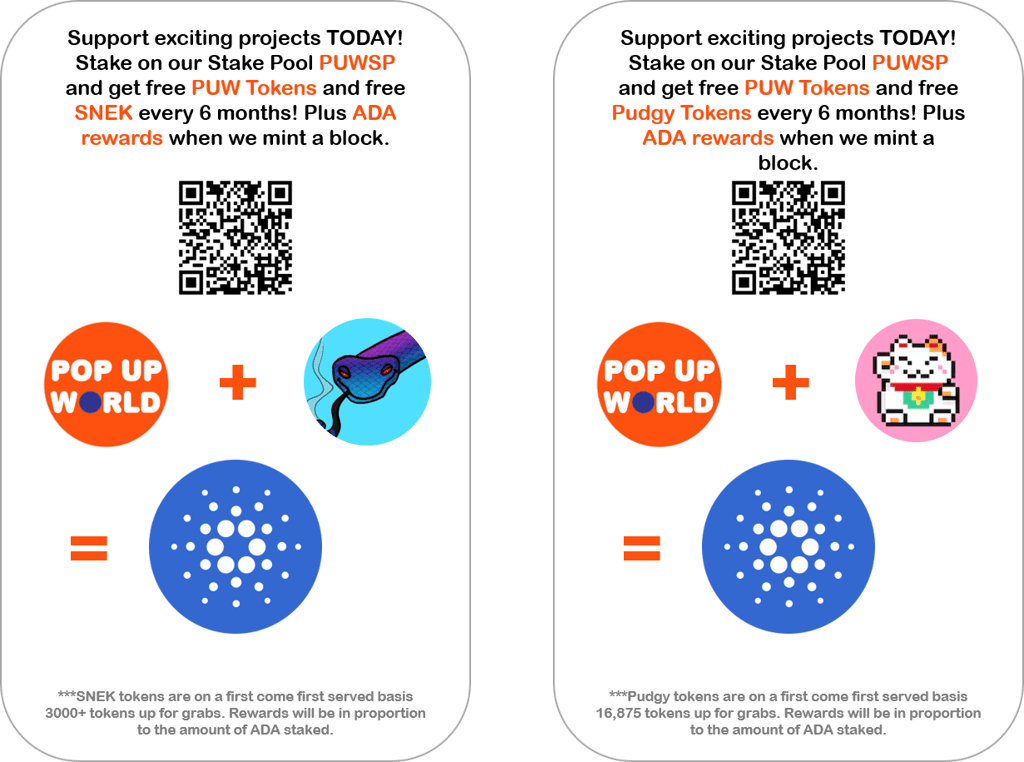
Earn and help support the Pop Up World Blog and entrepreneurs worldwide by joining our Pop Up World Stakepool! Go to https://popupworld.co.uk/popupworldstaking
Thanks!
Want to learn how to stake on Cardano? Read this article:
It starts with an idea. Pop Up World is a platform that helps start-ups and small businesses reach for the stars. No matter what size you are. Use our start-up guide Business Zero to Superhero, Design your Logo. Connect with investors via our Investor Connector. You can start a Website and Domain name. You can Search for and promote your Premises. You can promote your idea for free on our Pop Up World Ads site, you can even form a Limited Company You can also join us on our journey via the Pop Up World Token (PUW).
 Pop Up World Blog